Manual Muscle Testing in Applied Kinesiology: A Clinical Overview
Manual muscle testing (MMT) predates Applied Kinesiology by decades — the Kendall grading system, developed to track motor loss in poliomyelitis, remains the technical ancestor of the patient positioning used in AK today. What AK changed was the interpretive frame: rather than grading maximal force output on a fixed scale, the examiner is assessing how well the nervous system adapts a muscle’s output to a changing external load in real time. Schmitt’s phrase for this — muscle testing as functional neurology — is a useful shorthand for practitioners unfamiliar with the distinction.
The break test
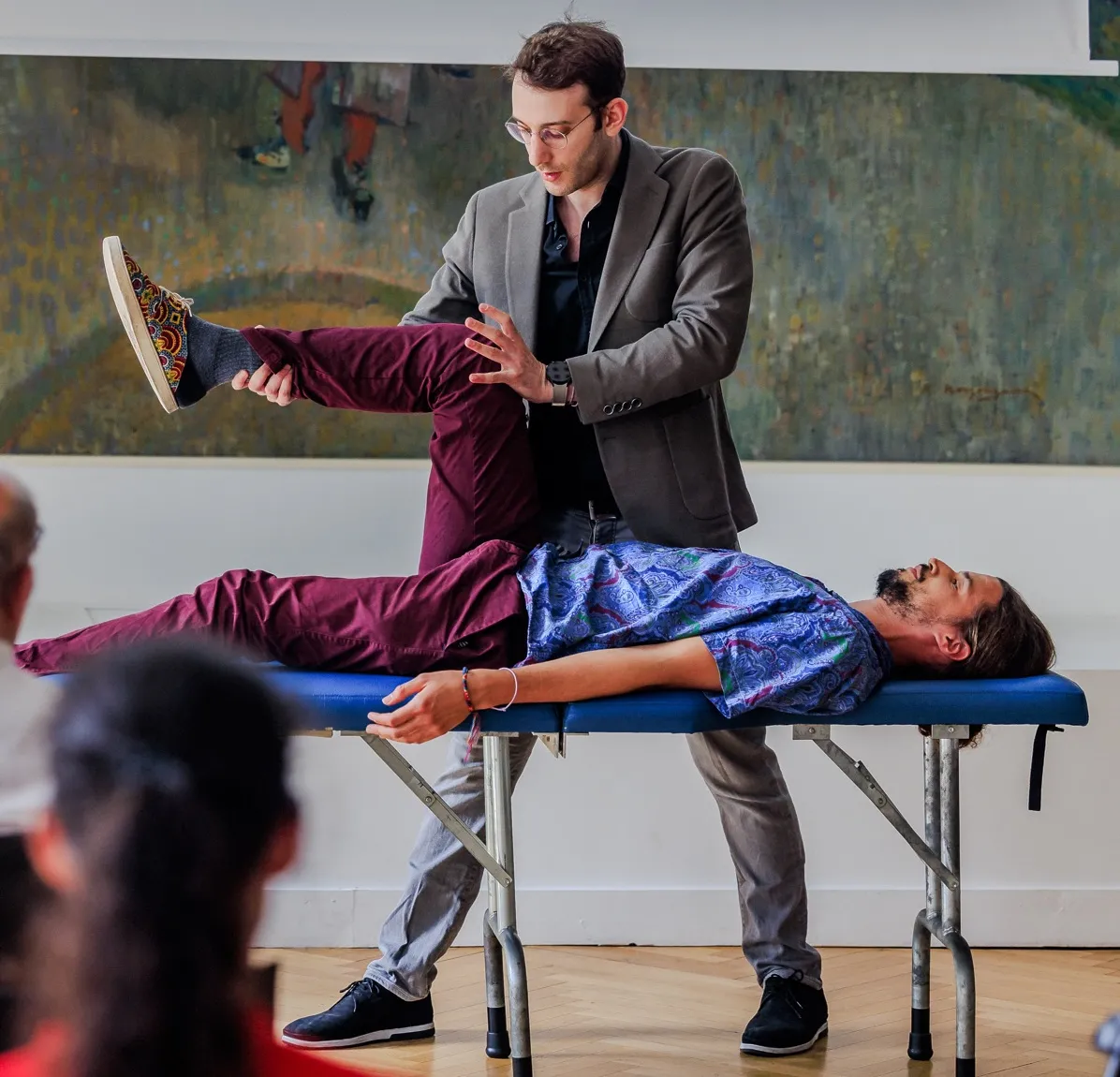
The technique itself is generally described as a break test: the examiner asks the patient to resist as pressure is applied, initially perceiving isometric “locking,” then increasing force enough to move the limb into eccentric contraction while the patient continues resisting. What’s being read is less the peak force generated than the muscle’s ability to keep adapting to the examiner’s increasing and changing pressure — which is why timing and rate of force application matter as much as magnitude, and why an examiner applying pressure very slowly can make a genuinely dysfunctional muscle appear to test strong.
Doctor-induced versus patient-induced testing
AK literature distinguishes at least three testing variants, sometimes labeled type 1/2/3 (formerly G-1/G-2/G-2 submax): a doctor-induced test, in which the examiner initiates and controls the pressure throughout; a patient-induced test to maximal force, in which the patient contracts fully before the examiner’s counter-pressure is applied; and a submaximal patient-induced variant. These are proposed, within the AK framework, to probe different levels of the nervous system — segmental findings correctable with local techniques such as spinal or joint manipulation and reflex point work; suprasegmental findings associated with chemical or stomatognathic factors; and findings tied to withdrawal-reflex, allergic, or visual-motor mechanisms. Practitioners should treat this taxonomy as the field’s internal working model rather than an independently validated neurophysiological classification — it is useful clinically as a way of organizing further workup, not as a settled mechanism.
Therapy localization
Much of AK’s diagnostic utility depends on therapy localization (TL): the patient touches a specific area, and a previously strong indicator muscle is retested for a change in response. The proposed mechanism draws an analogy to cutaneous afferent modulation of segmental motor output — comparable in logic, though not established as identical, to gate-control mechanisms in pain physiology. It remains a hypothesis rather than a demonstrated mechanism, and the companion article on the evidence base for muscle testing reviews the literature that has attempted to test TL specificity under blinded conditions.
Confounders every examiner must control
The interexaminer reliability literature on MMT is instructive largely because of what it reveals about technique-dependent variance. Factors that reliably change test outcomes, independent of any underlying pathology, include:
- Head and neck position. Tonic neck and tonic labyrinthine reflexes — present from infancy and persisting throughout life — predictably facilitate or inhibit specific muscle groups depending on cervical flexion/extension, rotation, and the supine/prone/side-lying orientation of the patient. An examiner unaware of these reflexes can easily misattribute a positional artifact to pathology.
- Proximal stabilization. Because nearly every muscle test involves some synergist activity, failure to stabilize the structure the tested muscle originates from allows substitution patterns that mask true findings — a classic example being pelvic rotation recruiting adductor synergism during a psoas test.
- Pain. A muscle “letting go” under painful loading is a distinct phenomenon from a functionally inhibited muscle, and the two are not always easy to separate without direct patient feedback during the test.
- Rate and timing of force application. As above — the single largest technique variable, and the one most associated with poor interexaminer agreement when uncontrolled.
Where this leaves the examiner
None of this argues against the technique; it argues for the discipline the literature itself calls for. AK’s own interexaminer studies bear this out directly: agreement between examiners rose from roughly four in five findings to full agreement once known confounders — cranial faults and ocular lock, in one study design — were controlled for. That pattern, discussed further in the companion piece on the research base, is the central clinical lesson of manual muscle testing: it is not an inherently unreliable exam, but it is a skill-dependent one, and its value is inseparable from the examiner’s command of the variables that can silently change the result.