Ileocecal Valve Syndrome: Symptoms, Causes and How Applied Kinesiology Assesses It
Some of the most puzzling symptoms patients bring to a doctor have nothing obviously to do with digestion. A headache that’s worst first thing in the morning. Low back pain that no adjustment seems to hold. A right shoulder that aches for no clear reason. Bloating that comes and goes, or a general feeling of being unwell that never quite resolves.
One of the first things an Applied Kinesiology practitioner may check in these situations is a small valve in your abdomen you have probably never heard of — the ileocecal valve. When it stops working the way it should, the resulting pattern is known as ileocecal valve syndrome, and it has been one of the most clinically useful findings in Applied Kinesiology since Dr. George Goodheart first described its examination and treatment in 1967.
This article explains what the ileocecal valve does, what symptoms point to a problem with it, how the two different patterns (open and closed) differ, what an Applied Kinesiology evaluation involves, and — importantly — when your symptoms need standard medical investigation first.
What is the ileocecal valve?
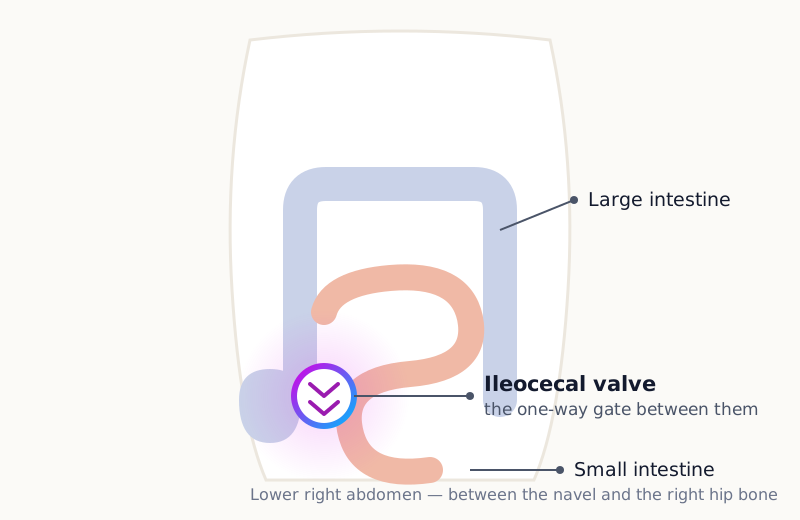
Your small intestine is where food is broken down and nutrients are absorbed. Your large intestine — the colon — is where what’s left is processed for elimination, and it holds a very large population of bacteria that belong there and should not travel backwards.
The ileocecal valve is the gate between the two. It is also called the ileocolonic valve or the ileocecal sphincter. It sits in the lower right quadrant of your abdomen, roughly midway between your navel and your right hip bone, where the last segment of the small intestine (the ileum) meets the first part of the colon (the cecum).
It has one main job, and it is an important one:
- Let material pass through from the small intestine into the large intestine at the appropriate time, once digestion is complete.
- Stop that material coming back, keeping the bacteria-rich contents of the colon out of the small intestine.
Anatomically the valve has two components working together: a ring of muscle that tightens and relaxes under nerve control, and a pair of folds shaped to act as a mechanical one-way flap.
What is ileocecal valve syndrome?
Ileocecal valve syndrome is the term Applied Kinesiology uses for the pattern of symptoms that develops when this valve stops opening and closing appropriately. There are two distinct presentations, and they behave differently:
Open ileocecal valve
The valve doesn’t close properly, so contents from the colon can move backwards into the small intestine — an area of the gut that is not built to handle them. The body’s response to that irritation is thought to account for many of the far-flung symptoms, including fluid retention that can put pressure on nerves and discs elsewhere in the body.
Closed (spastic) ileocecal valve
The valve stays tight and material has trouble passing through in the first place, so things back up behind it.
Both patterns can produce a similar-looking set of complaints, which is why practitioners test to distinguish them rather than assuming — the treatment and the nutritional support differ between the two.
Ileocecal valve syndrome symptoms
The most striking thing about ileocecal valve syndrome is that most patients do not complain about their digestion at all. The bowel usually carries on much as it always has. That’s exactly why the valve gets missed, and why an Applied Kinesiology practitioner will check for it regardless of what brought you in.
Symptoms reported in connection with ileocecal valve dysfunction include:
- Headaches, characteristically worse on waking
- Low back pain, sometimes with pain radiating down the leg
- A feeling of the right leg giving way
- Right groin pain
- Shoulder pain, often on the right
- Bloating or vague abdominal discomfort
- General fatigue, sluggishness or malaise without an obvious cause
- Symptoms resembling carpal tunnel syndrome — wrist and hand pain from fluid retention pressing on the median nerve
- Sudden onset of feeling generally unwell after a dietary change
The pattern that gives it away
There is a temporal pattern practitioners look for, and it’s worth checking against your own experience:
- Symptoms are worst first thing in the morning and ease once you’re up and moving, as bowel activity increases.
- Symptoms are noticeably worse on the mornings you sleep in — many patients report feeling considerably worse on weekends or holidays when they lie in.
If your bowel habits do change, in an open valve pattern the stool often changes to small balls, or stays full length but becomes noticeably narrower than your normal.
What causes ileocecal valve problems?
Applied Kinesiology considers all three sides of the triad of health — structural, chemical, and mental/emotional — as potential contributors, and in practice ileocecal valve syndrome often involves more than one:
Diet. This is the most common precipitant. Rough or irritating foods — popcorn, nuts, chips, coarse cereals, raw vegetables and fruit, spicy food, alcohol, caffeine — can provoke the valve. Practitioners often see seasonal patterns: late summer and autumn when fresh produce is abundant and consumption goes up, and holiday periods when sugar intake spikes. A high proportion of vegetarian patients have ileocecal valve involvement. Conversely, a chronically low-fiber, refined diet is frequently part of why the problem developed in the first place.
Structural issues. Misalignment in the lower back and dysfunction in nearby muscles — particularly the psoas, a deep muscle running from your lower spine to your thigh — are commonly found alongside the valve problem.
Stress and emotion. Emotional excitement normally speeds up the movement of material into the colon, and ongoing stress affects the adrenal glands in ways that associate with both the open and the closed pattern. Where the syndrome keeps coming back, stress is often a factor that hasn’t been addressed.
How Applied Kinesiology evaluates the ileocecal valve
Applied Kinesiology practitioners are licensed diagnosing physicians — medical doctors, doctors of chiropractic, osteopaths, dentists, and naturopathic doctors — who use manual muscle testing as one component of a standard clinical examination. It supplements a proper history and physical exam; it does not replace one.
To assess the ileocecal valve, your practitioner will typically:
- Take a full history and examine you conventionally first, including ruling out conditions that need medical attention.
- Ask you to place your own hand over the lower right area of your abdomen while they test the strength of a muscle. A change in the muscle’s response with your hand in that position is one signal the area warrants attention. This is called therapy localization.
- Apply gentle pressure over the area in different directions. Which direction changes the muscle response helps distinguish an open pattern from a closed one — this is called a challenge.
- Check what else is involved. The valve rarely misbehaves in isolation. Practitioners routinely examine the psoas and other related muscles, the lower back, the cranium, reflex points, and whether diet or stress is driving the pattern.
Nothing about this examination is painful or invasive. Manual muscle testing involves your practitioner applying steady pressure to a limb while you resist.
Ileocecal valve treatment: what to expect
Treatment is hands-on and conservative, combined with things you do yourself at home. A typical approach includes:
Manual treatment
Your practitioner will treat the valve area and the related reflex points, along with any structural findings — the psoas muscle, the lower back, and the cranium are all commonly involved. Where a swollen disc is part of the picture, note that forceful spinal adjusting is generally contraindicated until the fluid retention is addressed, which is one reason identifying the valve first matters.
A short-term, gentle diet
For about two weeks following treatment, practitioners generally recommend:
- Avoid roughage — coarse cereals, popcorn, peanuts, potato chips, raw vegetables and raw fruit. (Cooked vegetables and fruit are fine.)
- Avoid spicy foods — chiles, pepper, most condiments.
- Avoid alcohol, caffeine and cocoa.
Your practitioner will be clear with you that this is not a healthy long-term diet. It is deliberately bland and temporary, intended only to stop irritating an already-irritated area while it heals. Transitioning properly back to a normal diet with adequate fiber afterwards is an important part of the treatment, not an afterthought.
A cold pack at home
Cool water with a few ice cubes in a sealed bag — not an ice pack — placed over the lower right abdomen and allowed to warm slowly to room temperature.
Nutritional support
This depends on which pattern you have. Chlorophyll is commonly used for an open valve to help soothe and heal the bowel; calcium (sometimes with vitamin D, and occasionally hydrochloric acid where absorption is poor) is typical for a closed valve. Your practitioner will test to determine what’s appropriate for you.
What to avoid
Colon cleansing and standard enemas are generally considered counterproductive in ileocecal valve syndrome and can make things worse.
Many patients notice a change quite quickly — sometimes within a visit or two. Even so, staying with the gentle diet for the full two weeks matters, because the area needs time to settle after symptoms improve.
Frequently asked questions
Can I fix my ileocecal valve myself?
Some patients find temporary relief by pressing in on the lower right abdomen and drawing upward toward the left shoulder — practitioners sometimes use this in the office to demonstrate the connection, and some patients with low back pain can stand and walk more comfortably while holding the area this way. The cold pack described above is also a legitimate home measure. But self-treatment can’t distinguish an open valve from a closed one, can’t identify the associated muscular and structural involvement, and — most importantly — can’t rule out the conditions that produce similar right-sided abdominal symptoms. Get evaluated.
How long does it take to resolve?
Many patients improve quickly, but the two-week dietary period is standard, and where the underlying cause is dietary or stress-related, the syndrome can return if that isn’t addressed. Recurrence usually means something in the picture hasn’t been dealt with — often food sensitivities, adrenal stress, or a structural issue.
Is ileocecal valve syndrome recognised by conventional medicine?
The valve itself and its function are well described in physiology and surgical literature — the consequences of losing it during bowel surgery are well documented. Ileocecal valve syndrome as a named clinical pattern, and its assessment by manual muscle testing, comes from the Applied Kinesiology literature and is used by AK-trained physicians. It is best understood as a functional assessment used alongside standard medical care, not as a replacement for medical diagnosis.
Does it cause weight gain or bloating?
Bloating is commonly reported. Fluid retention is part of the described mechanism in the open pattern, which some patients experience as puffiness or a sense of being swollen.
What does the ileocecal valve have to do with back pain?
In the open pattern, fluid retention is thought to be part of the body’s response to material moving backwards into the small intestine. That fluid can cause swelling of an intervertebral disc, producing low back pain with sciatic radiation — pain that may not respond durably to treatment aimed only at the back. This is one of the clearest examples of why Applied Kinesiology examines the whole patient rather than only the painful area.
When to seek medical care first
Applied Kinesiology assesses function; it is not a substitute for medical diagnosis. Please see a physician promptly — and describe these symptoms specifically — if you have:
- Severe or worsening pain in the lower right abdomen, especially with fever, nausea or vomiting. This needs appendicitis ruled out urgently.
- Blood in your stool, black stools, or unexplained weight loss.
- A significant, lasting change in your bowel habits.
- Persistent vomiting, or a swollen abdomen with inability to pass stool or gas.
- A family history of colon cancer or inflammatory bowel disease, or you are due for colorectal screening.
A good Applied Kinesiology practitioner will want these possibilities addressed before treating. Assessing the ileocecal valve is about restoring normal function once serious conditions have been excluded — and it works best as part of, not instead of, ordinary medical care.
Finding an Applied Kinesiology practitioner
Every ICAK member has completed a 100-hour Basic Applied Kinesiology Certification course and passed both written and practical examinations, and members practice in 14 countries worldwide. If the symptoms described here sound familiar, you can find a certified practitioner through your national chapter.
Are you a practitioner? Read the clinical version of this article for assessment protocols, differentiation between open and closed presentations, and the supporting physiological literature.